How to Choose the Right Metal Nameplate
Choosing the right metal nameplate means matching its material, marking method, and attachment to the job it must do. Start with the information people need to read and the conditions the plate will face, then work through appearance, installation, and budget. This approach gives you a practical specification to discuss with a supplier, whether you need equipment identification or a decorative product badge.
What should you consider when choosing a metal nameplate?
The main considerations are purpose, environment, readability, material, marking process, and mounting method. Treat them as one specification rather than separate purchases: the plate must fit its application, retain useful information, and remain attached. Nameplate manufacturers likewise identify function, environment, visibility, branding, and cost as core design considerations.
Before comparing finishes, write a short application brief:
- Purpose: Identify a machine, track an asset, display operating information, or present a brand.
- Location: Describe indoor or outdoor use, sheltered or exposed placement, and the available mounting area.
- Exposure: List cleaning products, moisture, sunlight, heat, abrasion, and handling.
- Reading conditions: State who reads the plate, from what distance, and whether a scanner is involved.
- Service expectations: Explain whether the identification should last with the equipment or be replaced periodically.
Be specific where you can. Instead of requesting something “heavy duty,” describe the actual cleaning routine and operating conditions. Ask the supplier to identify any missing details before recommending a construction.
Match the metal to its working environment
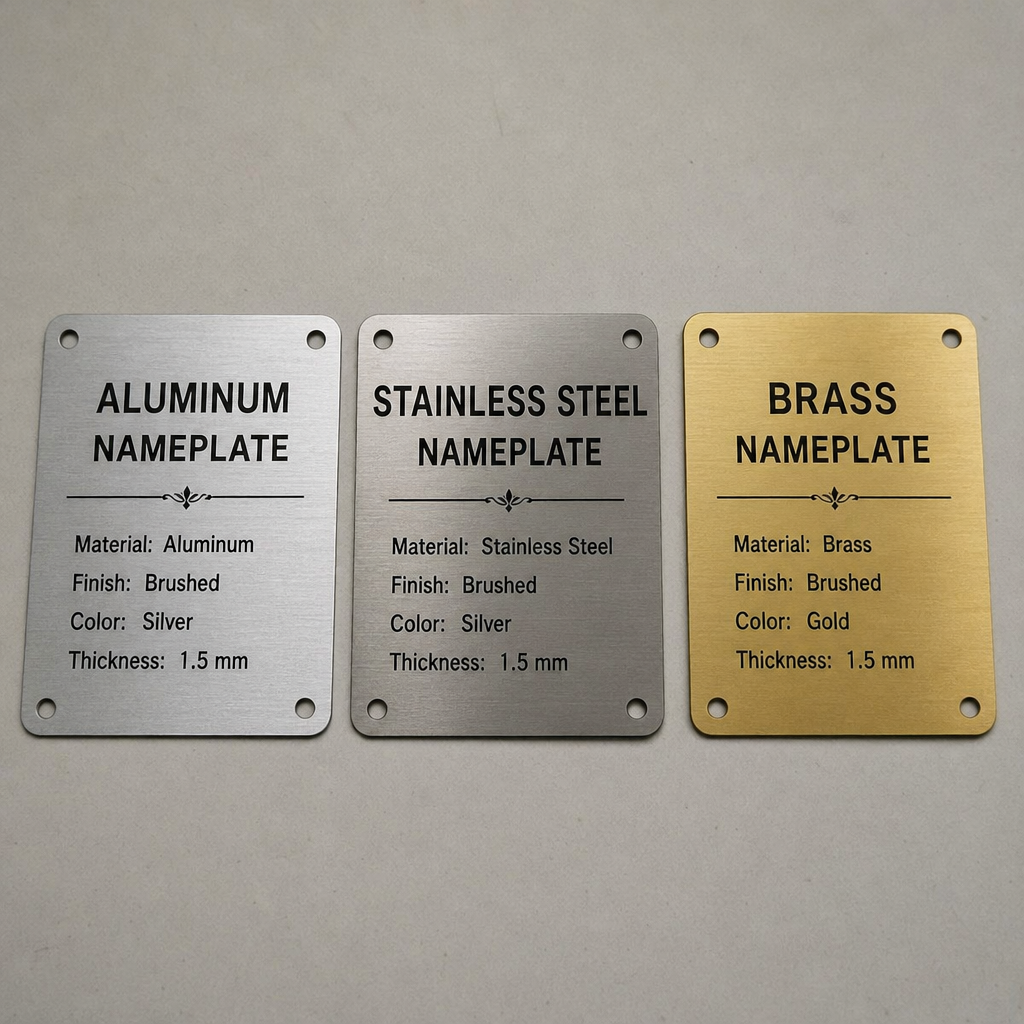
Aluminum, stainless steel, and brass are common nameplate materials, but each offers a different starting point. Aluminum is lightweight and versatile; stainless steel is often selected for demanding environments; brass offers a distinctive decorative appearance. The appropriate choice depends on exposure, finish, and the complete plate construction—not the metal name alone.
Aluminum for lightweight, versatile identification
Consider aluminum when weight, graphics, and finish options matter. Manufacturers offer both plain and anodized aluminum, with several marking and decorating processes available. Ask which specific combination suits your application rather than assuming that every aluminum plate has the same surface protection or graphic durability.
For a proposed equipment label, request a sample showing your smallest text and any variable information. Use it to assess the finished result, not just the appearance of a blank material swatch.
Stainless steel for demanding applications
Stainless steel deserves consideration when corrosion, abrasion, or harsh exposure drives the specification. Suppliers offer different grades, so “stainless steel” is not a complete material requirement. Ask the manufacturer to recommend a grade against your stated environment and confirm the compatible marking process.
For industrial nameplates, request the exact material description on the quotation. That makes repeat orders easier to compare and gives your purchasing team something more useful than a general promise of durability.
Brass for a distinctive appearance
Brass is an option when a decorative metal finish is central to the design. Nameplate suppliers offer it for architectural and premium-looking applications, alongside more utilitarian identification work. If appearance is the priority, ask about the finish and maintenance expectations before approving production.
Review a physical sample beside the product or surface it will accompany. Decide whether the tone supports the intended look, and document the approved finish so future orders have a clear reference.
Which marking method will keep your information readable?
The right marking method is the one that produces readable information and is suitable for the specified metal and exposure. Engraving, etching, laser marking, and photosensitive processing are distinct options; they should not be treated as interchangeable descriptions. Ask suppliers to name the actual process and explain why it fits your application.
When comparing metal nameplate engraving options, distinguish the visual result from how it is produced:
- Engraving: Ask whether the process removes material, what the finished characters look like, and whether a contrasting fill is included.
- Laser marking: Request the specific technique. Laser processing can involve engraving, coating removal, or annealing, which changes the metal’s appearance without removing material.
- Etching or photosensitive processing: Ask how the information is formed and what protection the finished graphics have.
These process distinctions matter when reviewing samples and quotations. A smooth, dark laser mark is not necessarily a recessed engraving, while a recessed character does not automatically establish its readability in your application.
If you want engraved metal plates, specify the desired result rather than relying on that phrase alone. Request a representative sample, including any paint fill or coating. For custom engraved tags, check the smallest characters and the longest identifier, not only a large logo.
Design around the information people need
Make a full-size proof before approving artwork. Put the most important identifier where readers can find it immediately, then arrange supporting details in a clear order. For metal identification tags, prioritize identification over decoration unless branding is the primary purpose.
Use this review checklist:
- Content: Confirm spelling, model references, serial numbers, units, and any approved symbols.
- Hierarchy: Make the key identifier easy to locate without searching through secondary text.
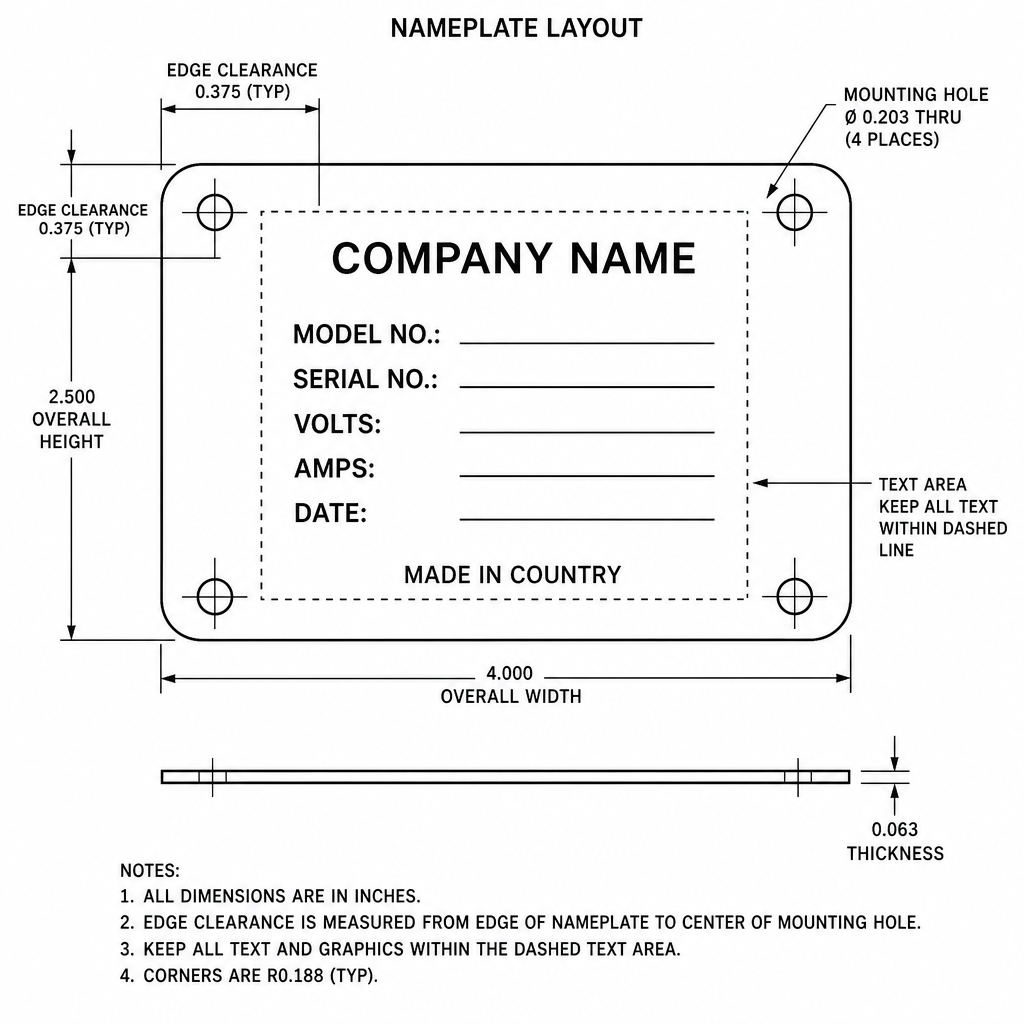
- Space: Keep text clear of edges, mounting holes, and hardware.
- Variable data: Test the longest expected entry and preserve meaningful leading zeros.
- Scanning: If a code is included, request a finished sample and test it with the intended reader.
Ask the person who will actually use the plate to review it. A maintenance technician may need a different information order than a customer inspecting a product badge. Settle those priorities before making the plate smaller to save space.
If a requirement comes from a customer drawing or internal specification, supply that document with the artwork. Do not ask the nameplate manufacturer to infer required content from an old photograph.
Choose mounting alongside the plate
Adhesive backing and mechanical fasteners are established nameplate attachment options. The choice depends on the receiving surface, plate construction, and operating environment; manufacturers recommend testing the proposed adhesive in the intended application. Mechanical attachment also needs to account for plate thickness and attachment-point loads.
For adhesive mounting, tell the supplier what the plate will bond to, including any paint, texture, or curvature. Request the adhesive’s application instructions and a sample for evaluation. Do not assume that a backing described as permanent is suitable for every surface.
For screws or rivets, confirm hole positions against the equipment drawing. Check installation access, hardware clearance, and whether drilling is permitted. If the supplier proposes combined adhesive and mechanical attachment, ask them to explain the installation sequence.
Compare complete specifications, not just unit prices
Build a common specification before requesting quotes for custom metal tags. Ask each supplier to quote the same material, dimensions, thickness, marking process, finish, attachment, and quantity. Where a supplier recommends an alternative, have it listed separately with the reason for the change.
Request a breakdown of setup, artwork, tooling, variable-data handling, samples, packaging, and shipping where applicable. Confirm what is included rather than assuming every quotation covers the same work. Also ask how repeat orders are handled and what information you need to retain.
Use the comparison to identify differences, not simply the lowest number. If one proposal changes the material or marking process, resolve that difference before choosing. A cheaper quote is only a useful comparison when you understand what you would receive.
Approve a sample before committing
Before releasing a full order, review a sample that represents the proposed construction as closely as possible. Check the material, finish, dimensions, artwork, and attachment against your specification. If production samples are unavailable, ask the supplier to identify exactly how the supplied sample differs.
Run a practical approval sequence:
- Read it: Inspect the smallest text at the intended locati0n and distance.
- Fit it: Check mounting space, hole alignment, and access.
- Try it: Evaluate the recommended attachment and relevant exposure conditions.
- Record it: Save the approved artwork, material details, and sample reference.
Document any limitations in the evaluation. A visual approval alone should not be mistaken for confirmation of performance under conditions you have not tested.
Choose the complete identification solution
Start with the job, then specify the material, marking, layout, and attachment together. Give suppliers a clear application brief and use comparable quotes and representative samples to resolve uncertainty. The goal is a metal nameplate that fits the equipment, communicates clearly, and meets your documented expectations—not simply one that looks right on a screen.